




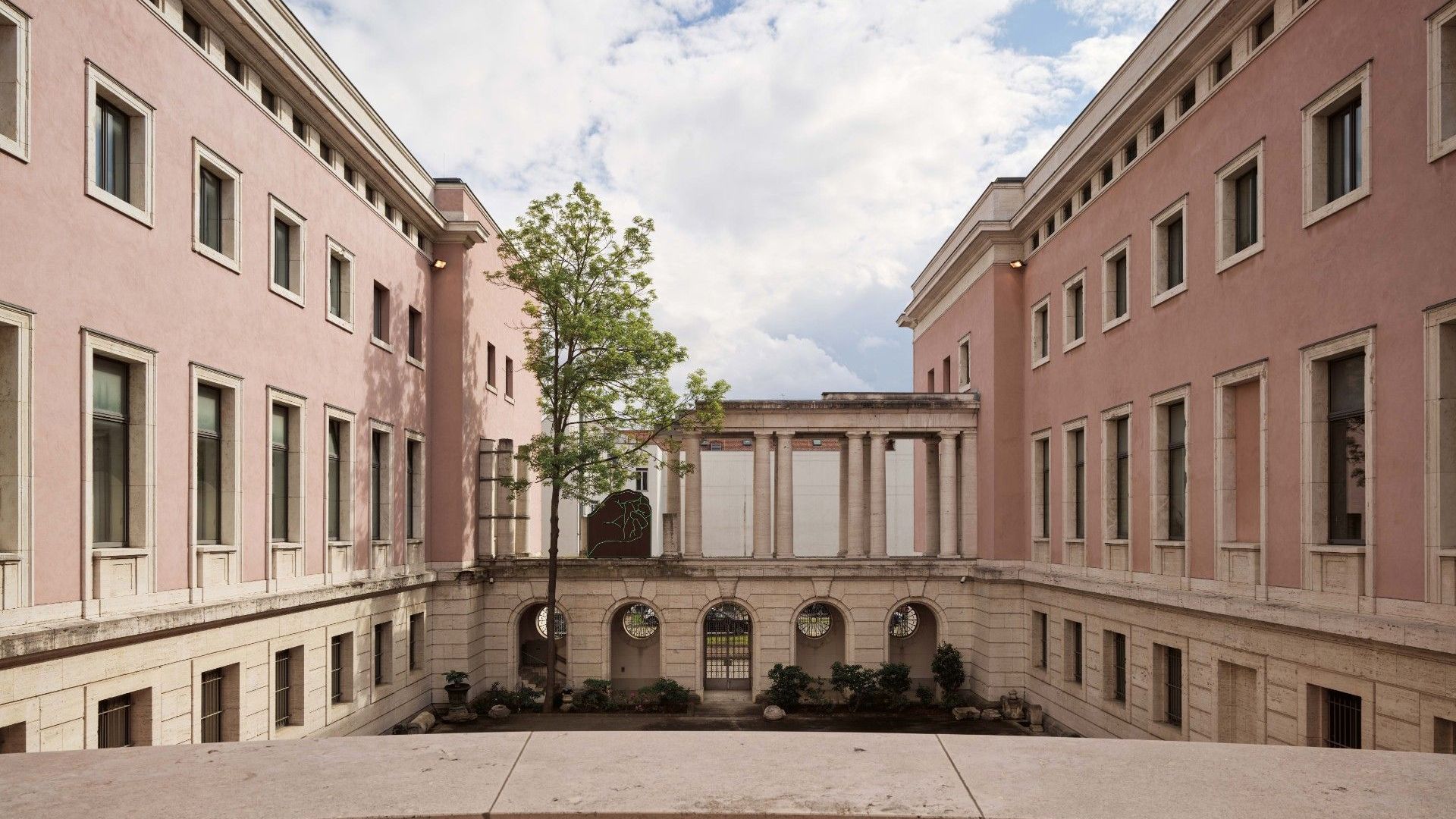
The interior courtyard of the neoclassical building housing the Italian Embassy in Berlin.
октября 2026
The Italian Embassy in Berlin
A diplomatic residence where history lives with the present, amid natural light, works of art and furnishings chosen to recount Italian elegance.
“This place has a life of its own. It changes with the daylight. The morning light is completely different from that of the afternoon.” The Italian Embassy in Berlin stands in a privileged position in the diplomatic quarter, next door to the city’s large Tiergarten park. The pink facade of the imposing neoclassical building stands in contrast to the green of the trees. Although built in the late 1930s and located in the heart of Berlin, the building, immersed in greenery and bathed in a soft delicate light, is far removed from urban bustle. Fabrizio Bucci, Italian Ambassador to Germany since the beginning of 2025, is fascinated by the complex layered history of his official residence. Built in the National Socialist era, the building stood almost unused for several years following damages during the Second World War. The building was only restored after the fall of the Berlin Wall, reopening in 2003.
“Italy chose not to fully restore the building to its original state – explains the Ambassador – but to preserve some traces of the destruction as a warning against war.” In fact, the void in the colonnades of the interior courtyard still exists and bullet holes are visible on the outside walls.
The interiors hold surprises too. Amid the marble columns and antique paintings are works by Italian artists Monica Bonvicini and Rosa Barba, both resident in Berlin. The Embassy also houses works by Emilio Vedova, a leading figure of Italian Informal Art, who lived in West Berlin for a time in the 1960s.
It was Bucci and his team who had the idea of introducing modern accents into the sumptuous neoclassical spaces, and this is the basis of their collaboration with Edra, invited to renew the rooms of the piano nobile with furnishings and lighting, and introduce sofas into some of the salons and the Ambassador's office.
"Edra represents design, the Italian character and quality materials. The founder's son, Niccolò Mazzei, is a figure reminiscent of a contemporary Renaissance man: he combines entrepreneurship, taste, art, culture, and craftsmanship. All of this can also be found in his furnishings" Bucci tells us.
The heart of the building is the colonnaded gallery on the main floor. From here, visitors have access to the ballroom and reception rooms. A balcony overlooking the courtyard invites guests to take a quiet moment in the open air. Natural light enters rooms through large windows creating an almost magical atmosphere. Artificial lighting is limited to discreetly recessed ceiling lights, while in the ballroom, two magnificent Murano glass chandeliers catch the eye with their rich colours. Instead, in the reception rooms, Edra's ironic Ines floor lamps appear, liberally extending gilded arms in all directions.
"When German friends come and visit us, they expect to feel like they're in Italy. They expect beauty and elegance. That’s why, with Edra, we have chosen the best of the best."
It is even more significant then, that the collaboration continues out onto the piano nobile terrace, overlooking the interior courtyard, where outdoor pieces by Edra have created a welcoming enjoyable atmosphere. This outdoor space has been rediscovered, together with a partly forgotten rooftop terrace that Ambassador Bucci and his team wanted to bring back to life as a space open onto the city, with views of the Tiergarten’s expanse of trees, and destined for summer evenings Italian-style, between aperitifs and conviviality.


